
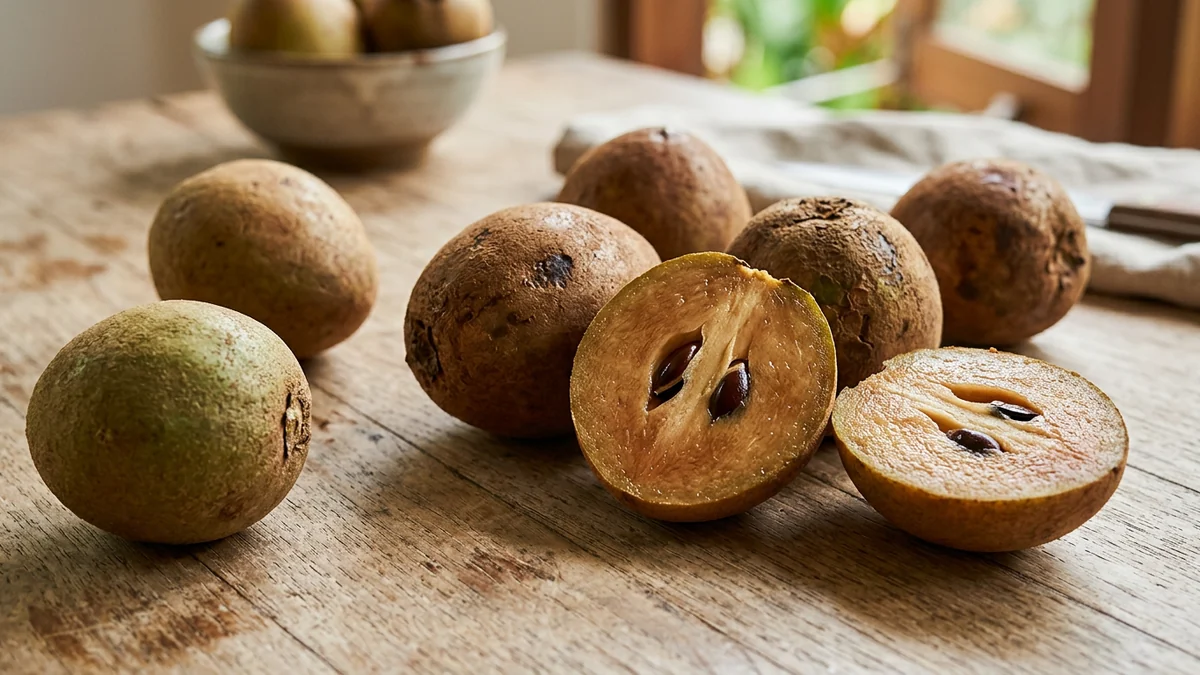
At the stall, brown is not enough
Sapodilla is a quiet fruit. A banana announces itself with colour. A mango often gives fragrance before it is cut. Sawo does not help that much. It is brown before it is ready, brown when it is ready, and still brown when it has gone too far.
That is why people in a fruit stall tend to use their hands. In Surabaya, Probolinggo, Bogor, or any warm town where fruit sits in shallow baskets, a seller may press near the shoulder of the fruit, turn it once, then say, “Yang ini besok bisa.” This one may be good tomorrow.
In a small stall, the sorting is often simple. Softer fruit goes to the front because it should be eaten soon. Firmer fruit stays behind or in another basket. Sometimes the seller will slip two nearly ripe fruit into one thin plastic bag and add one harder fruit for later. It is not a scientific system, but it is a system.
Sometimes the seller is right. Sometimes tomorrow becomes the day after. Sometimes the fruit softens but the inside is still dry, sticky, or strangely flat. Anyone who buys sawo often enough knows this small disappointment.
The problem is not only patience. Waiting works only if the fruit was already mature enough when it left the tree. If it was picked too young, the kitchen table cannot repair everything.
Hard fruit is not always the same kind of hard
A mature but unripe sapodilla can be firm in a good way. It has weight. The skin feels dry and slightly rough. There is no wet crack, no sour smell near the stem, no sunken patch that gives too easily. Left on the table, it begins to soften evenly.
An immature fruit behaves differently. It may sit for days, then wrinkle. It may soften on one side and remain gummy elsewhere. Julia Morton’s description of sapodilla in Fruits of Warm Climates is useful here: immature fruit is often hard, gummy and astringent, while mature fruit may still be hard at harvest but can ripen after storage at room temperature.
This matters because sapodilla has latex in its background. The tree is associated with chicle, the gummy latex once used for chewing gum. In a good ripe fruit, you do not think much about that history. In a fruit picked too early, the sticky, dry feeling can still be there.
So the market question is not simply, “Is it soft?” A bruised fruit can be soft. An overripe fruit can be soft. A young fruit can turn soft in a poor way. Better fruit usually softens with some balance.
The slow work after harvest
Sapodilla can continue to ripen after harvest. FAO/WHO Codex material lists sapodilla among climacteric fruits, the group of fruits whose ripening is linked with respiration and ethylene. In simple terms, the fruit is still alive for a while after you bring it home.
It uses oxygen. It releases carbon dioxide. It changes its own flesh. You do not see much happening in the first few hours. Then one morning the fruit that felt hard yesterday gives a little under your thumb.
A sapodilla study by Zhong Qiuping, Xia Wenshui and Yueming Jiang measured this process more closely. The researchers used 1-methylcyclopropene, or 1-MCP, a compound used in postharvest research because it interferes with ethylene action. Treated fruit showed delayed respiration, delayed ethylene production and delayed polygalacturonase activity.
Polygalacturonase sounds far from the kitchen, but the result is familiar. As ripening moves forward, cell-wall materials break down and the flesh loses firmness. In the same study, untreated sapodilla dropped to about 8.5 newtons of firmness after 12 days, while treated fruit remained much firmer. A buyer at the market does not need those numbers. Still, the numbers confirm what the hand can feel: softening is a real biological process, not only a surface change.
There is a catch. A fruit can soften for bad reasons too. Too much squeezing, a fall during transport, or being trapped in a hot plastic bag can all produce soft spots. Good ripening is usually even. Damage is often local.
Why ripe sawo tastes sweeter
People usually say ripe sawo becomes sweeter. That is true in the mouth, though the story is not only about sugar.
During ripening, aroma develops, astringency drops, the flesh becomes less resistant, and soluble solids become easier to perceive. Total soluble solids, or TSS, are often used as a rough reading of sweetness in fruit quality work. Literature reviewed by Indonesian researchers from Universitas Padjadjaran notes sapodilla’s sugar-rich profile and its potential as a tropical fruit in Indonesia, even though it is less popular than fruits such as banana, orange and mango.
At home, the change feels simpler. A firm fruit can taste dry even if it already contains sugar. A ripe one lets the sweetness spread. The flesh gives way. The grainy texture becomes pleasant instead of stubborn. The aroma becomes warmer, sometimes almost brown-sugar-like.
This is why cutting sawo too early is disappointing. The fruit may be technically edible, but the eating experience has not arrived yet.
What I would do with five sapodillas
If I buy five sapodillas, I do not want all five at the same stage. That only creates pressure. Either they are all not ready, or suddenly all of them must be eaten at once.
A better mix is two nearly ready fruit, two firm-mature fruit, and one harder fruit if the seller seems confident. In a real market, this is often negotiated in a few seconds. The buyer presses one fruit, the seller presses another, and both pretend the answer is obvious.
At home, I would remove them from the plastic bag and place them on a plate or shallow basket. Not hidden. Sawo is easy to forget when it is tucked behind rice containers or covered by other fruit.
Check once in the morning and once later in the day. Not with force. Press gently near the shoulder. The fruit should give a little, not collapse. If one fruit ripens first, eat it or move it to the refrigerator for a short hold. Do not leave one very ripe fruit buried under the rest.
In many Indonesian homes, fruit is not kept in a special fruit rack. It may sit beside bananas, near the rice cooker, on top of the dining table, or close to a sunny window by accident. That is normal. Just avoid damp plastic and crowded piles. A warm, humid kitchen can push fruit along faster than expected.
Cold storage is useful, but not magic
The refrigerator is useful only at the right moment.
If the fruit is still firm and needs to ripen, putting it into the refrigerator too early slows the process you are waiting for. If the fruit is already ripe and you cannot eat it the same day, refrigeration can buy time. That is its job.
A study from Universitas Gadjah Mada tested UV-C exposure and storage temperature on sapodilla. One useful point for home readers is the temperature comparison: fruit kept at a lower storage range, about 16.70–18.13°C in the study, ripened about six days later than fruit held around room temperature. A home refrigerator is usually colder than that, so the exact result cannot be copied directly. But the direction makes sense. Cooler storage slows ripening.
The practical note is plain: ripen first, chill later. If you chill too early, the fruit may stay firm longer without becoming better.
Some days, even with care, the fruit is not perfect. That is normal. Sawo passes through many hands before it reaches the kitchen. Weather, harvest timing, transport and storage all leave marks.
Small checks before cutting
Look for even give. Smell near the stem. Avoid fruit with a fermented smell, wet cracks, or one soft sunken area. Brown skin by itself tells very little.
If there is fine dust or soil on the skin, wipe it gently before storing. Do not wash the fruit and then put it back into a plastic bag while still damp. That is a small mistake, but it happens often.
If the fruit is ripe, the knife should pass through without fighting. The flesh should be soft but not watery. If it feels sticky, dry, or sharply astringent, the fruit may have been picked too young or cut too soon.
None of these checks is perfect. They are just better than guessing by colour.
Sources used
- FAO/WHO Codex Alimentarius discussion paper CX/FL 11/39/7 was used for the climacteric fruit context and its listing of sapodilla among fruits that can ripen after harvest.
- Zhong Qiuping, Xia Wenshui and Yueming Jiang, Food Technology and Biotechnology 44(4), 535–539, 2006 was used for the discussion of 1-MCP, ethylene, respiration, polygalacturonase activity and firmness.
- Wahyuni, Trisnowati and Mitrowiharjo, Vegetalika, 2013 was used for the storage-temperature note and the finding that lower-temperature storage delayed ripening by about six days compared with room temperature.
- Budiarto, Dwinanda, Pakpahan and Komala, Jurnal Kultivasi, 2023 was used for Indonesian context on sapodilla’s production and relative popularity.
- Julia F. Morton, Fruits of Warm Climates: Sapodilla was used for descriptive notes on under-ripe fruit and the latex/chicle background of the plant.
The sources help explain the process. The market still teaches the small habits: ask the seller, keep the fruit visible, and check it gently.