
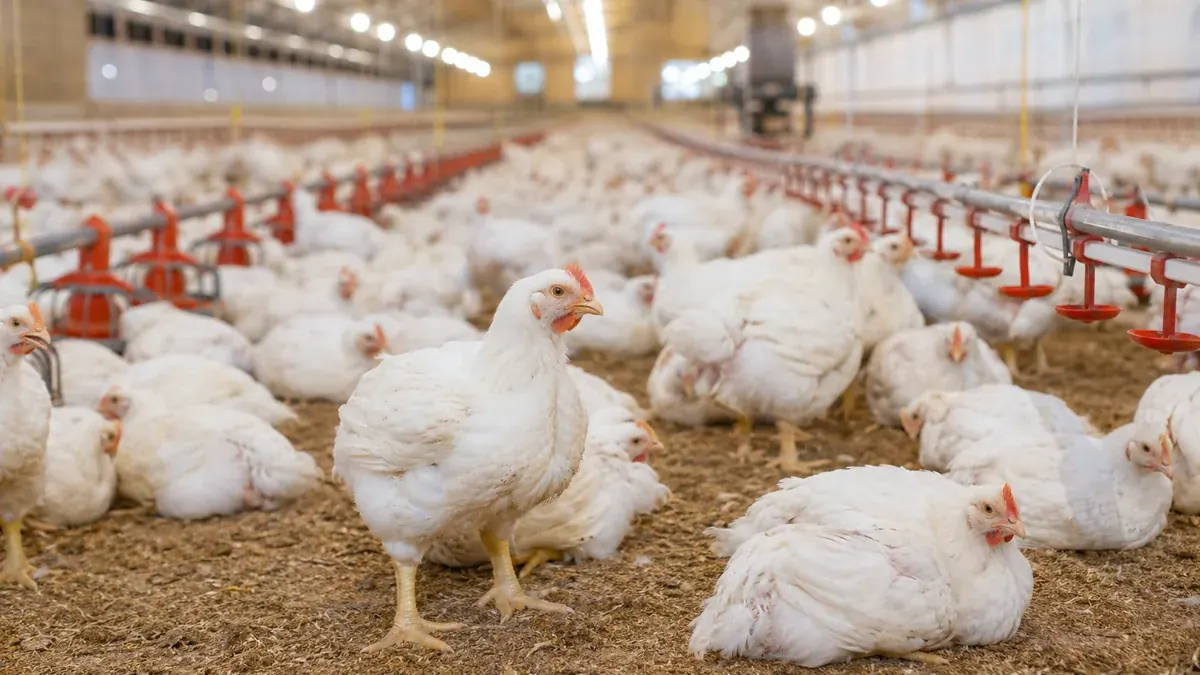
Broilers are raised for meat efficiency
Broiler chickens are poultry bred and managed for meat production. Their growth depends on chick quality, feed formulation, water availability, temperature control, ventilation and health management.
The fast production cycle makes management discipline important. A small mistake in brooding, water access or ventilation can affect growth, uniformity and welfare throughout the flock.
The first week sets the foundation
Day-old chicks need warmth, clean water, easy feed access and even distribution across the house. If chicks crowd, pant, avoid feed or sit too quietly, the environment is telling the farmer something.
Good early management is not only about survival. It shapes gut development, immune strength, feed conversion and final weight uniformity.
Feed, water and air must work together
Broilers need balanced feed, but feed performance depends on clean water and fresh air. Poor ventilation can increase ammonia, wet litter and respiratory stress, reducing the value of even a good ration.
Farmers therefore monitor water lines, litter condition, bird behavior and house temperature together. Broiler management is a system, not a list of isolated inputs.
Processing and cold storage complete the chain
After harvest, poultry quality depends on humane handling, hygienic slaughter, chilling, packaging and temperature control. Weakness after the farm can undo good production work.
Consumers see the final package, but the package carries the history of breeding, farming, processing, storage and distribution. Understanding that chain helps explain why reliable poultry supply requires coordination.
A realistic delivery example
A supply chain becomes easier to understand when it is followed through one product. Frozen chicken may leave a processing facility in good condition, but quality can still decline if loading takes too long, the truck temperature is unstable, or the receiving team does not record arrival temperature. In that case the problem is not simply “bad chicken”; the weak point may be the handoff between processing, transport and receiving.
The same logic applies to coffee or corn. Coffee can be dried carefully at the farm, then lose buyer confidence if sacks are stored on a damp floor. Corn can meet a moisture target at purchase, then become risky if it is stacked without airflow during a humid week. Good supply chains make these weak points visible before they become disputes.
Documents are not paperwork for paperwork’s sake
A delivery note, lot code, moisture result, temperature log or receiving checklist does not make a product better by itself. Its value is that it connects a physical condition to a date, a person and a batch. When a buyer asks what happened to a shipment, records reduce guessing.
Small operators do not need a complicated system at the beginning. A notebook or spreadsheet that records supplier name, harvest or packing date, vehicle, quantity, basic quality check and buyer receipt can already improve accountability.
What readers can observe in their own market
At a traditional market, warehouse, small farm or food business, the same question is useful: where does control become vague? The answer may be at loading, weighing, sorting, chilling, labeling or receiving. Improving that one point often has more impact than adding a new slogan about quality.
How the references support this article
The sources below support general principles on farming, soil, water and post-harvest practice. Field conditions vary, so practical decisions should be adapted to local conditions.
A simple lot trail readers can picture
Imagine a small shipment of dried ginger moving from farmers to a village collector, then to a warehouse and finally to a buyer. At each point the product may be weighed, re-bagged, sampled or delayed. If each step records only quantity but not condition, the chain knows how much moved but not whether quality changed.
A better lot trail records condition as well as movement: date received, lot source, visible defects, moisture or temperature where relevant, packaging condition and the person who accepted it. This is the practical difference between a product that simply travels and a product that travels with proof.
Why “farm to buyer” is not a straight line
Many readers imagine a supply chain as a straight road from farm to final buyer. In reality, agricultural products often pass through collectors, sorting points, transporters, warehouses, processors and retailers. The more handoffs there are, the more important it becomes to keep identity and condition visible.