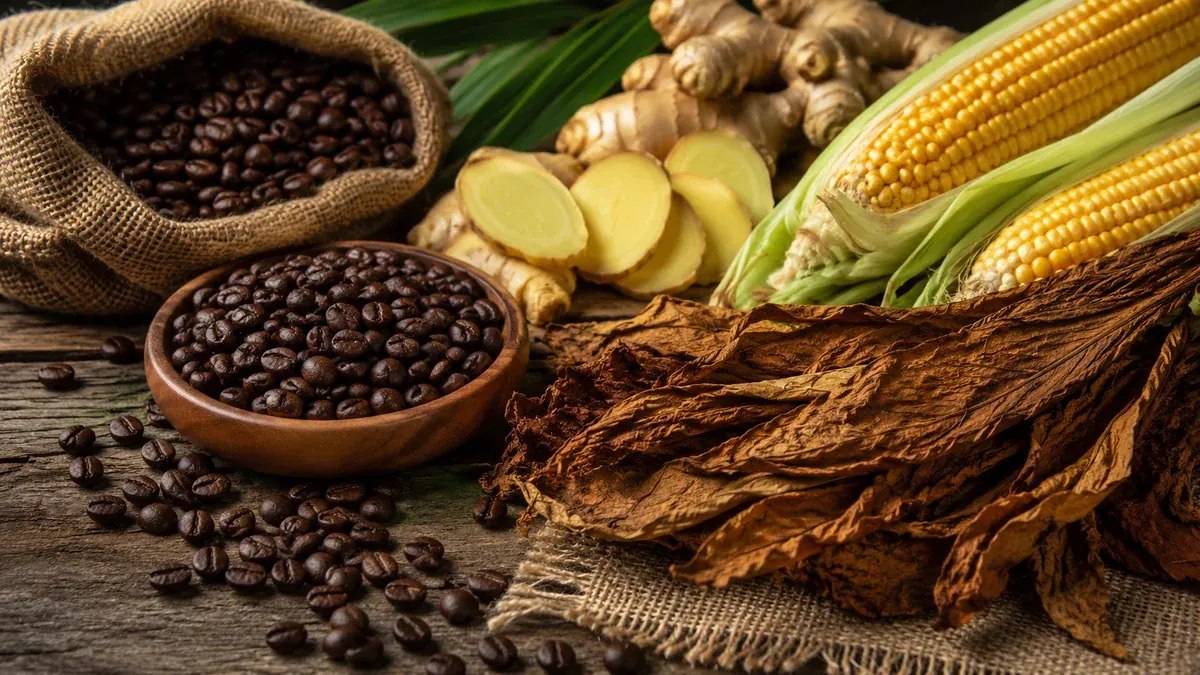
What Are Agricultural Commodities? Grading, Moisture and Buyer Readiness

Key Takeaways

  • Different varieties of agricultural products are essential for market diversity.
  • Various pricing strategies are utilized in the commodity trading landscape.
  • Numerous uncertainties can impact agricultural transactions and trading practices.
  • Technological advancements significantly enhance agricultural efficiency and productivity.

Types of Agricultural Commodities

The agricultural sector is a vibrant tapestry woven from an array of commodities, each falling into distinct yet overlapping categories—think food grains, oilseeds, fruits, and vegetables. Food grains like wheat and corn aren’t just mere staples; they’re the backbone of diets across numerous populations and pivotal players in the vast arena of national economies. Then we have oilseeds—soybeans and sunflower seeds—that fuel not only our kitchens with oils but also bolster livestock through protein meals, creating a dual-purpose powerhouse for both humans and animals alike.

Diving deeper, fibers such as cotton and wool emerge as indispensable threads for the textile industry’s fabric. And let’s not overlook livestock along with dairy products—they form a cornerstone of agricultural output that underpins food security while anchoring economic stability. Each commodity type dances to its own rhythm: their distinctive traits shape trade dynamics and market behaviors in intricate ways that ripple through pricing structures and demand patterns on the global stage. The interplay is anything but linear; it’s a complex web where every twist influences what we see at marketplaces worldwide!

Primary Categories and Their Characteristics

Agricultural commodities, oh the vast landscape they cover! They can be sliced and diced into several primary categories, each flaunting its own quirks. Take grains—our stalwart heroes like wheat, corn, and rice—which form the very backbone of global food supplies, doling out those essential carbohydrates that fuel our daily lives. And let's not forget oilseeds! Those little powerhouses like soybeans and canola are indispensable when it comes to producing vegetable oils and feeding livestock. Then there are staples—potatoes that comfort us in myriad forms and sugar that sweetens everything from desserts to sauces—all playing crucial roles in diverse cuisines across the globe.

But wait! There's more—a whole other dimension lies within livestock and animal products: cattle grazing under wide-open skies, hogs snuffling around for scraps, poultry flapping about merrily. These creatures are not just farm fixtures; they’re vital protein sources for hungry mouths worldwide. And we can't overlook fruits and vegetables—an explosion of colors on our plates catering to health enthusiasts while tantalizing taste buds with their endless variety. Each category pulses with life as it contributes to the agricultural economy—a vibrant tapestry woven from regional diversity and ever-shifting consumer trends.

Pricing Mechanisms in Commodity Markets

In the intricate tapestry of commodity markets, a myriad of factors dance together to determine how prices are born and evolve. At the heart of this chaotic ballet lie the age-old forces of supply and demand—ever-shifting entities influenced by seasonal whims, bountiful or scarce crop yields, and the fickle desires of consumers. Yet, lurking in the shadows are external players: government policies that twist market dynamics like a puppeteer’s strings; trade agreements that can pivot on a dime; geopolitical tensions that loom ominously over trading floors—all capable of sending ripples through agricultural pricing.

Navigating these turbulent waters requires market participants to wield an arsenal of pricing mechanisms. Spot contracts emerge as lifelines for those seeking immediate engagement at prevailing prices—a rush towards liquidity that fuels rapid transactions. On another front, futures contracts stand as fortresses against uncertainty, allowing buyers and sellers to anchor their hopes in fixed prices for deliveries yet to come—a strategy steeped in risk management wisdom. For producers and investors alike, grasping these mechanisms isn’t just beneficial; it’s essential for making astute decisions amidst the relentless ebb and flow of agricultural trading's vibrant landscape.

How Prices Are Determined

The intricate dance of supply and demand weaves a critical tapestry that defines the pricing of agricultural commodities. Picture this: when an abundance of a certain crop floods the market, prices often plummet as sellers scramble to offload their products in fierce competition. On the flip side, if Mother Nature deals a harsh blow to yields or consumer cravings shift dramatically, you can bet those prices will soar skyward. Farmers, wholesalers, retailers—each player in this vast arena is perpetually reacting to these mercurial shifts, crafting a constantly evolving price landscape.

Then there's the wild card of market speculation—a force all its own shaping how prices are set. Traders delve into an array of signals: weather forecasts twist and turn like autumn leaves; export figures rise and fall with unpredictable rhythm—all in pursuit of predicting future supply-and-demand scenarios. Their moves can trigger swift surges or drops in commodity prices that may leave actual supply situations gasping for breath. And let’s not overlook the macroeconomic currents swirling beneath it all—currency fluctuations and inflation loom large on the horizon too—adding yet another layer of complexity to the already tangled web surrounding agricultural commodity pricing.

Commodity Current Price (per ton) Supply Status Demand Trend
Wheat $250 High Supply Stable Demand
Corn $300 Medium Supply Increasing Demand
Soybeans $400 Low Supply High Demand
Rice $200 Medium Supply Stable Demand

Risk Factors in Agricultural Trading

Agricultural trading dances on the precarious edge of myriad risk factors that can send market stability into a tailspin. The whims of weather are paramount, casting shadows over crop yields and, in turn, dictating supply levels and prices with an unpredictable hand. A sudden drought, an unexpected flood, or a raging hurricane—these natural disasters inject chaos into the equation, compelling traders to keep their eyes glued to environmental forecasts like hawks watching for prey. And let’s not forget about pests and diseases; they lurk as silent saboteurs to agricultural output, unleashing erratic swings in commodity availability.

Then there's the tempest of market volatility—a formidable adversary lurking in every corner of agricultural trading. Prices can leap or plummet at a moment's notice thanks to shifts in consumer demand or abrupt changes in import/export policies—or even currency fluctuations that feel like punches thrown out of nowhere! This whirlwind complicates decision-making processes for traders who must deftly navigate through this tumultuous landscape where costs and profit margins can morph dramatically within mere moments. To thrive amid such uncertainty requires a deep understanding of these dynamics—a crucial foundation for crafting savvy trading strategies that not only mitigate risks but also amplify profitability amidst the chaos.

Understanding Volatility and Market Fluctuations

In the realm of agricultural trading, the labyrinth of volatility presents a critical puzzle for all stakeholders involved. A cacophony of factors—erratic weather patterns, shifts in supply and demand dynamics, and geopolitical upheavals—conspicuously orchestrates market fluctuations that can leave even seasoned traders reeling. Take, for instance, those capricious weather whims: one moment you might be basking in the glow of a bumper harvest, while the next could plunge you into despair over catastrophic crop failures. Such unpredictable elements reshape market supplies with relentless fervor.

Yet, it’s not just Mother Nature pulling the strings; economic policies and international trade agreements weave an intricate web that significantly colors these price oscillations as well. Tariffs dance across borders like phantom shadows; subsidies trickle down from policy-makers with promises unfulfilled; consumer preferences shift like sand beneath our feet—all catalyzing ripple effects through commodity prices that are anything but predictable.

To navigate this tumultuous landscape effectively demands more than mere awareness—it calls for a profound comprehension of these multifaceted dynamics. Traders who master this art stand poised to make astute decisions—a potential lifeline amid chaos—that could mitigate risk while simultaneously amplifying profitability within this ever-volatile agricultural arena.

The Role of Technology in Agriculture

Technological advancements have ignited a revolution in agricultural practices, ushering in an era of unprecedented innovation. Picture this: precision farming tools—those GPS-guided tractors and nimble drones—are now the farmers’ eyes in the sky, meticulously monitoring crop health while optimizing resource usage with uncanny accuracy. This isn’t just a mere enhancement; it’s a paradigm shift that amplifies efficiency, slashes waste, and propels overall productivity to new heights.

But wait! The story deepens with data analytics software weaving its magic. It sifts through vast oceans of information on weather patterns, soil conditions, and pest management strategies—transforming raw data into actionable insights that empower farmers to make astute decisions grounded in real-time intelligence.

And let’s not overlook biotechnology—a game-changer at the forefront of modern agriculture. Genetically modified organisms (GMOs) are crafted with precision to fend off pests and diseases like brave sentinels guarding their fields. This engineering marvel paves the way for bountiful yields while curbing dependence on chemical inputs that once ran rampant across farms.

As if that weren't enough, enter smart irrigation systems—the unsung heroes conserving precious water resources while ensuring crops receive precisely what they need for optimal growth. The interplay between cutting-edge technology and agriculture is not merely progress; it's a transformative journey that's reshaping our future food production landscape one breakthrough at a time!

Innovations Enhancing Commodity Quality

Oh, the world of agriculture—it's a whirlwind of transformation! The leaps in agricultural technology are nothing short of remarkable, revolutionizing the very essence of our commodities. Picture this: precision farming techniques wielding GPS and cutting-edge data analytics, enabling farmers to keep a watchful eye on every nuance of crop health and soil vitality like never before. This laser-focused approach ensures that resources are utilized with pinpoint accuracy, leading to bountiful yields and products that practically sing with quality.

But wait—there's more! Enter biotechnology, the sorcerer’s apprentice in this narrative, conjuring up genetically modified organisms (GMOs) endowed with supercharged traits. Think resistance to pesky pests and an impressive shelf life that makes your produce last longer than ever. It’s as if science has gifted us crops dressed for success!

And let’s not overlook the sustainable practices making waves across fields and farms alike! Innovations such as vertical farming towers scraping against skylines and hydroponics systems dancing with nutrients are redefining space utilization while slashing pesticide usage. These eco-friendly methods don’t just preserve our planet—they also ensure that what graces our plates retains all those luscious characteristics we crave.

As consumers increasingly clamor for top-notch quality married to sustainability, the agricultural sector is riding this exhilarating wave of change. With each passing day, it embraces innovations that elevate both excellence and ecological mindfulness—a splendid dance between progress and preservation in an ever-evolving tapestry of food production!

  • Improved crop monitoring through drone technology providing real-time data.
  • Use of artificial intelligence to predict soil health and optimize planting schedules.
  • Development of advanced irrigation systems that conserve water and enhance crop growth.
  • Adoption of organic farming techniques that promote biodiversity and reduce chemical inputs.
  • Implementation of blockchain technology for transparent supply chain management.
  • Installation of quality control sensors in post-harvest stages to ensure product consistency.
  • Emphasis on regenerative agriculture practices that restore soil health and enhance resilience.

Conclusion

The terrain of agricultural commodities is in a state of flux, molded by an array of influences—think technological leaps and the ever-shifting tides of market dynamics. Grasping the fundamental categories of these commodities becomes essential for stakeholders who seek to navigate this labyrinthine landscape, making savvy decisions while wrestling with the intricate pricing mechanisms that govern market behavior.

Amidst a backdrop fraught with risk factors like volatility and unpredictable market ebbs and flows, the infusion of cutting-edge technologies emerges as vital. This marriage between innovation and agriculture doesn't merely enhance commodity quality; it sparks a revolution in efficiency that cultivates resilience against the relentless churn of an evolving marketplace.

FAQs

What are agricultural commodities?

Agricultural commodities—those raw, untamed treasures of the earth—are cultivated and gathered for the marketplace. Think grains that sway in golden fields, vibrant fruits bursting with flavor, crisp vegetables waiting to be plucked, and livestock that roam under wide-open skies. These goods often dance through various trading arenas, their prices shifting like shadows cast by the sun, dictated by the ever-changing tides of supply and demand.

How are agricultural commodities graded?

Grading agricultural commodities is an intricate process rooted in specific benchmarks like size, color vibrancy, moisture levels—a veritable checklist of quality indicators. This grading system becomes a universal language for buyers and sellers alike; it ensures that what’s offered meets agreed-upon standards so everyone knows exactly what they’re getting into.

What role does moisture content play in agricultural commodities?

Moisture content looms large on the stage of agricultural quality—it’s a pivotal player when it comes to shelf life and overall appeal. Too much moisture can spell disaster; spoilage creeps in uninvited alongside mold's unwelcome presence—all leading to diminished market value. Thus, vigilant producers must constantly monitor this elusive factor during both harvesting and storage phases.

How do pricing mechanisms work in commodity markets?

Ah! The world of pricing mechanisms—their intricacies woven from threads of supply-demand relationships intertwined with speculative whims. External forces such as fickle weather patterns or sweeping global economic currents add layers of complexity too. Prices fluctuate fluidly; they emerge either from bustling exchanges or arise through direct haggling between eager buyers and determined sellers.

What are some common risk factors associated with agricultural trading?

The landscape of agricultural trading is dotted with potential pitfalls—from wild market volatility to unpredictable weather fluctuations that shift like sand beneath one's feet. Pest infestations lurk ominously while consumer preferences ebb and flow unpredictably. Each risk carries its own weighty consequences—potentially destabilizing prices and encroaching on profitability within this vital sector.