
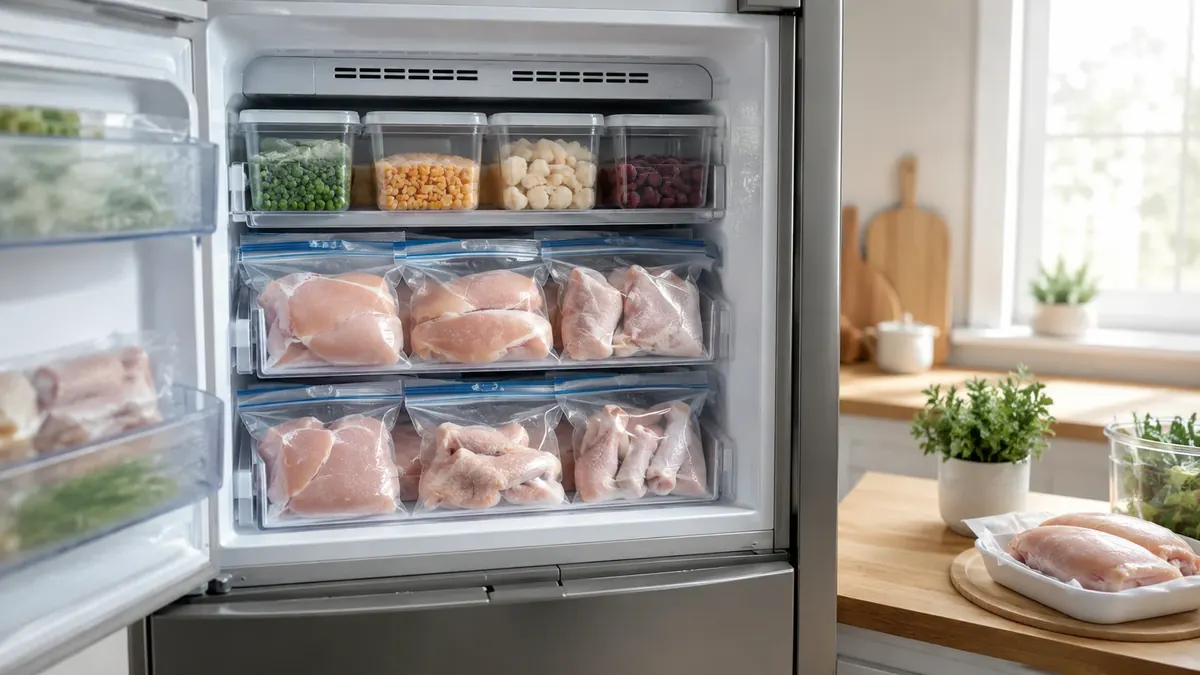
Quality loss usually comes from air and temperature swings
Chicken can remain safe in the freezer for a long time when kept properly frozen, but quality can decline through freezer burn, odor absorption and ice crystal damage.
The main enemies are trapped air, loose wrapping, slow freezing, overloaded freezer space and repeated door opening. Managing those details helps chicken cook better after thawing.
Portion before freezing
Freezing chicken in meal-sized portions makes thawing easier and reduces the temptation to thaw more than needed. Flat packs freeze faster and stack more neatly than thick bundles.
For households, portion labels can include cut type, weight and packing date. A simple label prevents old packs from disappearing at the back of the freezer.
Wrap for the freezer, not only for the trip home
Thin retail packaging may be fine for short transport but weak for longer freezer storage. Extra freezer-safe wrapping or bags reduce air exposure and help prevent dryness.
Remove as much air as practical before sealing. Vacuum packing is useful, but careful manual wrapping also improves quality when done consistently.
Use inventory discipline
A freezer works better when there is space for air circulation and a clear first-in, first-out habit. Overloading slows freezing and makes it harder to find older packs.
The practical routine is simple: date every pack, keep raw poultry separated, group similar cuts and plan thawing before cooking day. Quality is preserved by small habits repeated every week.
A cold-chain problem often starts during waiting time
Frozen chicken is vulnerable during the small gaps between controlled spaces: after it leaves a freezer room, while it waits near a loading door, during vehicle loading, or when it arrives before the receiver is ready. The product may still look frozen, but repeated temperature fluctuation can damage texture and increase drip after thawing.
For household readers, the same principle applies after shopping. Chicken should not spend a long time in a warm car or on a kitchen counter before going into the freezer. The safer routine is to portion it quickly, seal it well, label the date and return it to stable freezing conditions.
Practical signs that handling is weak
Excess ice crystals inside the pack, torn packaging, strong odor after thawing, unevenly frozen pieces and missing labels are not just cosmetic problems. They suggest that the product has been exposed to air, temperature fluctuation or unclear handling history.
In commercial supply, arrival checks should be simple but consistent: packaging condition, visible thawing, product temperature where possible, delivery time and whether the lot identity matches the document.
How the references support this article
The sources below support general food safety, storage and handling principles. For medical, industrial or regulatory decisions, readers should follow the applicable official guidance.
A practical freezer example
Consider two packs of chicken bought on the same day. One is portioned, sealed tightly, labeled and placed at the back of the freezer. The other is left in a loose bag, opened several times and stored near the door where temperature changes more often. After a month, both are still frozen, but the eating quality can be very different.
The same principle applies at business scale. A shipment can be technically frozen, yet quality can suffer if cartons are crushed, pallets block airflow, or doors stay open during loading. Frozen quality is protected by routine, not by temperature alone.
What to record when quality matters
Households can write dates on packs. Businesses can record lot number, product type, loading time, receiving time, visible thawing, packaging damage and temperature checks. These records help separate a product problem from a handling problem.
From supplier handling to household handling
Chicken quality connects several decisions: slaughter and processing hygiene, chilling, packing, freezing, transport, receiving and home thawing. A mistake at any point can reduce quality even when the next step is done well.
That is why consumers should not only ask whether chicken is frozen, but also whether the pack is intact, whether there is excess ice, whether the label is clear and whether thawing is planned safely before cooking.