
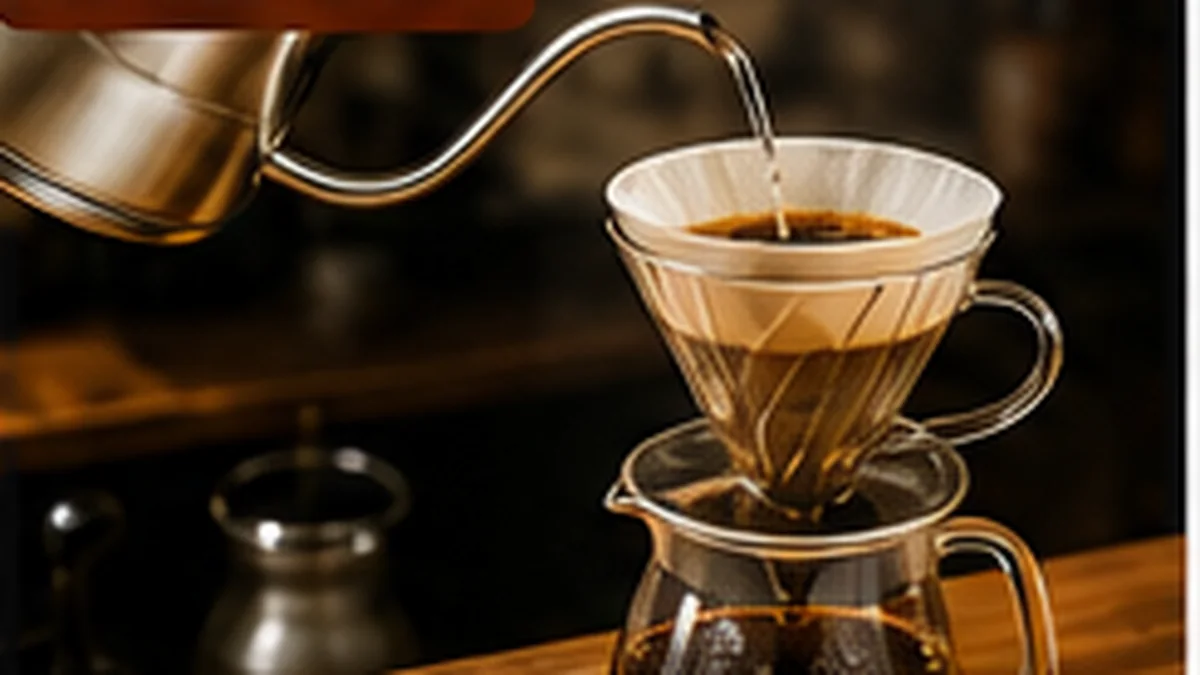
Manual methods solve different problems
Pour over, AeroPress and French press are not better or worse in a universal sense. They control water contact, filtration, agitation and immersion differently.
Choosing a method should start with the cup you enjoy. If you like clarity, pour over may fit. If you want flexibility and speed, AeroPress is useful. If you prefer body and texture, French press is hard to ignore.
Pour over rewards control
Pour over uses percolation: water passes through a coffee bed and filter. Grind size, pouring pattern, water temperature and brew time shape clarity and balance.
It can produce clean, aromatic cups, but it also exposes mistakes. Uneven pouring or a poorly prepared coffee bed can create channels, making some grounds over-extracted and others under-extracted.
AeroPress offers a wide recipe range
AeroPress combines immersion, filtration and pressure. It can brew concentrated cups, clean filter-style cups or short strong recipes depending on grind, time, water and pressure.
Its advantage is flexibility. The same brewer can serve travelers, office drinkers and home enthusiasts who like experimenting without complex equipment.
French press emphasizes body
French press uses immersion and a metal filter, leaving more oils and fine particles in the cup. The result is often heavier texture and fuller body.
The tradeoff is clarity. To reduce muddiness, use a consistent coarse grind, avoid over-agitation and pour gently after brewing so sediment stays behind.
The method changes contact, not magic
Pour over, AeroPress and French press are different because they manage contact between water and coffee differently. Pour over uses percolation and paper filtration, AeroPress uses immersion plus pressure, and French press keeps grounds in contact with water before metal filtration. The result is not one best method, but different body, clarity and texture.
A practical home test is to use the same coffee, the same water and a similar ratio, then change only the brew method. If too many variables change at once, the drinker learns less from the result.
What makes home brewing more repeatable
Grind size, water temperature, brew time and freshness matter more than buying new equipment. A cheap scale and a consistent recipe often improve coffee more than a new dripper used without measurement.
How the references support this article
The sources below support the general background on coffee quality, post-harvest handling and trade. Practices still need to be adjusted to variety, weather, farm scale and buyer specification.
A home brewing example that teaches more
If a coffee tastes bitter in French press, the answer may not be “bad coffee.” It may be a grind that is too fine, steeping that is too long, or water that is too hot. If the same coffee tastes thin in pour over, the problem may be too coarse a grind or water passing through too quickly.
Good home brewing is a feedback loop. Change one variable at a time and write down what changed. This turns daily coffee into a small experiment rather than a guessing game.
How to troubleshoot with one change at a time
If coffee tastes sour, the grind may be too coarse, brew time too short or water too cool. If it tastes harsh, the grind may be too fine, contact too long or the dose too high. Changing everything at once hides the cause.
A useful home habit is to write a small recipe: coffee weight, water amount, grind, brew time and taste result. This makes the next cup easier to improve.
How better brewing saves money
Better brewing can make an ordinary coffee more enjoyable without buying a new machine. If the grind is adjusted, the ratio is measured and water is used consistently, the same beans often taste clearer and more balanced.
This matters because many home brewers blame the coffee first. Sometimes the problem is not the bean but the repeatability of the brewing process.