
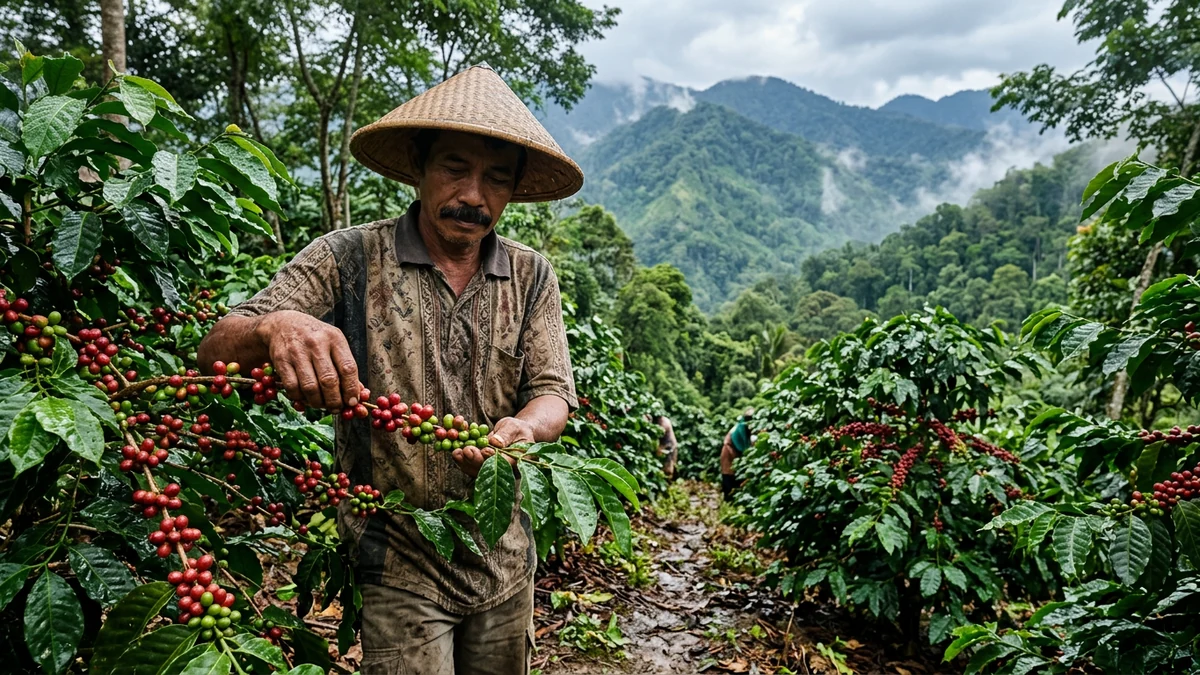
Coffee quality is often discussed after roasting, but much of the potential is decided earlier, while the fruit is still on the tree. Shade, rainfall and harvest timing influence how coffee cherries develop, how evenly they ripen, and how much care is needed after picking.
Indonesia is a useful place to study this because coffee is grown across islands with very different microclimates. A farm in a highland area of Sumatra will not behave exactly like a farm in Java, Bali, Flores or Sulawesi. Even within one region, slope, shade trees, soil depth and rainfall pattern can change the final cup.
Coffee quality begins while the cherry is still on the tree
A coffee cherry is a fruit. Like other fruit, its flavor potential depends on how it develops. If the plant is stressed, if nutrition is weak, or if cherries are harvested before they fully mature, the beans inside may carry less sweetness and more roughness. Processing can improve clarity, but it cannot create ripe fruit that was never there.
Good farmers therefore watch the tree long before harvest. They observe flowering, leaf condition, pest pressure, rainfall, soil moisture and the speed of cherry development. These observations help them decide when to pick, how often to return to the same tree, and which cherries should be separated.
Shade changes the speed of ripening
Shade is not simply decoration around a coffee farm. In many systems, shade trees reduce heat stress, soften direct sunlight, protect soil life and help conserve moisture. Under balanced shade, cherries may ripen more slowly and evenly, giving the plant more time to develop sugars and structure.
Too much shade, however, can create other problems. It may reduce airflow, increase humidity, slow drying after rain, or encourage certain disease pressures. Too little shade can expose plants to heat, especially during dry periods. The right shade level depends on altitude, variety, spacing, soil and local weather.
For buyers, shade is not a guarantee of flavor. It is a clue about how the farm manages temperature, moisture and plant stress.
Rainfall can help or hurt at different stages
Rain is necessary for coffee growth, but timing matters. Rain before flowering, during fruit expansion, near harvest and during drying can affect quality in different ways. A well-timed wet period can support growth. Heavy rain during harvest can make picking and drying more difficult.
When ripe cherries are picked during a rainy period, farmers may struggle to dry them quickly and evenly. If drying is delayed, fermentation, mold risk and inconsistent moisture can appear. Rain can also increase the cost of labor because pickers may need to return more often to collect cherries at the right maturity.
Harvest timing decides how much potential enters the basket
Selective picking is one of the clearest differences between routine coffee and carefully managed coffee. If ripe, underripe and overripe cherries are all picked together, processing becomes a compromise. Underripe cherries can add astringency or grassy notes. Overripe cherries can create heavy fermented flavors if not handled carefully.
In many smallholder systems, selective picking is difficult because labor is expensive and harvest windows are short. But even partial improvement helps: separating obvious green cherries, floating out damaged fruit, and avoiding long delays between picking and processing can protect quality.
What farmers can control after a difficult season
Farmers cannot control all weather, but they can control decisions after weather problems appear. If rain interrupts harvest, cherries should be processed as soon as practical. If drying space is limited, smaller batches may be safer than spreading too much coffee too thickly. If cherries are uneven, separation is better than forcing all fruit into the same process.
Simple records also matter. Notes on rain events, harvest dates, drying duration and moisture checks help farmers understand why one lot performed better than another. Over time, this can improve both farming decisions and buyer communication.
How buyers should read farm-level quality
Buyers should avoid treating origin labels as shortcuts. A region can suggest certain tendencies, but farm-level practices still matter. A coffee from a respected area can disappoint if harvest selection and drying are poor. A lesser-known area can produce excellent lots when plant health, picking and processing are disciplined.
Better questions include: how were cherries selected, how quickly were they processed, how was drying managed during rain, and how was moisture verified before storage? Those questions reveal more than a broad origin name alone.
Origin labels are a starting point, not a guarantee
A label such as Sumatra, Java, Sulawesi or Bali gives a clue about growing environment and local trade habits, but it does not guarantee flavor by itself. Variety, altitude, harvest selectivity, processing, drying, storage and roasting all shape the cup.
This is why two coffees from the same island can taste different, and two coffees from different islands can sometimes feel surprisingly close. The better question is not only “where is it from?” but “how was this lot grown, picked, processed and stored?”
A more useful way to compare coffees
For everyday drinkers, comparison becomes clearer when coffees are brewed with the same ratio, grind and water. For buyers, comparison also requires defect checks, moisture stability and sample consistency. Origin is meaningful when it is connected to lot-level evidence.
How the references support this article
The sources below support the general background on coffee quality, post-harvest handling and trade. Practices still need to be adjusted to variety, weather, farm scale and buyer specification.