
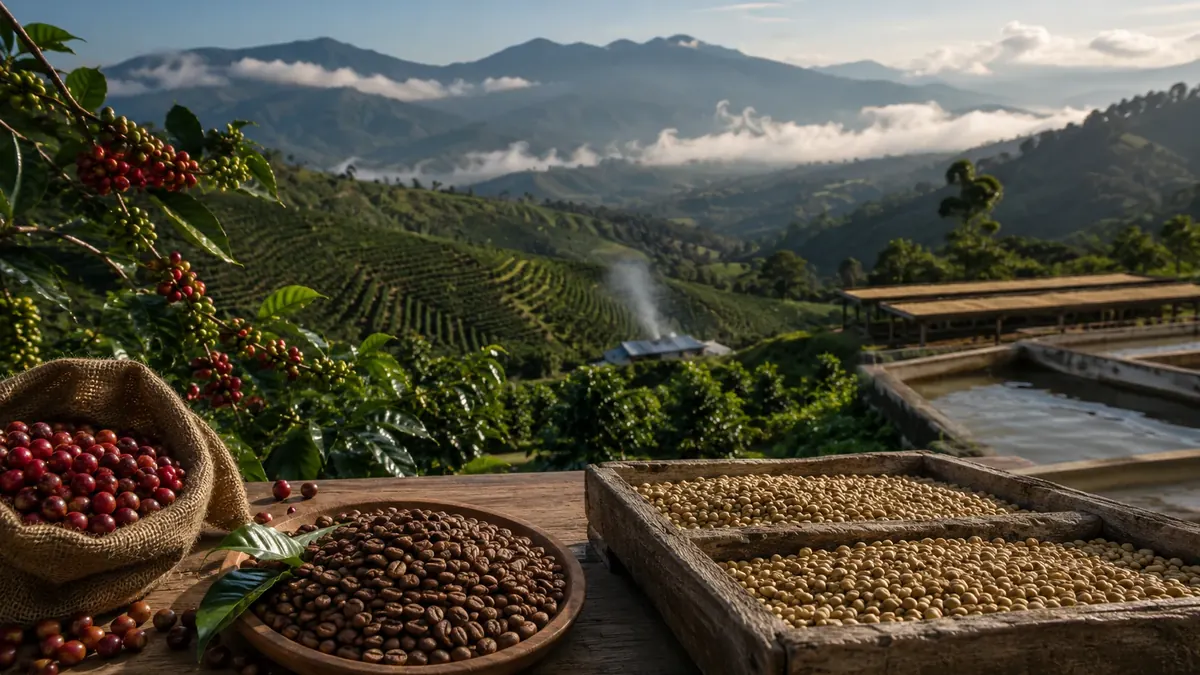
Origin is a clue, not a promise
Coffee origin can suggest flavor tendencies, but it does not guarantee a cup profile. Altitude, rainfall, temperature, variety, farm care, harvest selectivity, processing and storage all influence the final taste.
Two farms in the same region can produce different coffees if one harvests ripe cherries carefully and the other mixes maturity levels. Origin matters most when it is connected to actual practices.
Altitude and temperature change cherry development
Higher elevations often slow cherry ripening, allowing acids, sugars and aromatic compounds to develop differently. But altitude works together with shade, sunlight, rainfall and variety.
A lower farm with excellent processing can outperform a higher farm with poor drying. That is why buyers should taste coffee and review processing notes rather than relying only on altitude claims.
Processing can amplify or mute origin character
Washed, natural and honey processes expose coffee to different levels of fruit contact, fermentation and drying risk. Processing can highlight clarity, sweetness, fruitiness or body, but it can also create defects if poorly managed.
Origin tells where the coffee comes from; processing explains part of how the raw material was transformed. Both should be considered when comparing lots.
Storage protects what the farm created
Green coffee continues to be affected by moisture, temperature, odor and time after processing. Poor storage can flatten aroma or introduce baggy, moldy or aged notes.
A good origin story should therefore include post-harvest handling: drying targets, packaging, warehouse condition and shipment timing. Flavor is preserved, not only produced.
Origin labels are a starting point, not a guarantee
A label such as Sumatra, Java, Sulawesi or Bali gives a clue about growing environment and local trade habits, but it does not guarantee flavor by itself. Variety, altitude, harvest selectivity, processing, drying, storage and roasting all shape the cup.
This is why two coffees from the same island can taste different, and two coffees from different islands can sometimes feel surprisingly close. The better question is not only “where is it from?” but “how was this lot grown, picked, processed and stored?”
A more useful way to compare coffees
For everyday drinkers, comparison becomes clearer when coffees are brewed with the same ratio, grind and water. For buyers, comparison also requires defect checks, moisture stability and sample consistency. Origin is meaningful when it is connected to lot-level evidence.
How the references support this article
The sources below support the general background on coffee quality, post-harvest handling and trade. Practices still need to be adjusted to variety, weather, farm scale and buyer specification.
A buyer’s table tells the story
At a buying table, process names are only the beginning. A natural coffee may be attractive if fruit notes are clean, but it can be rejected if fermentation becomes winey, moldy or unstable. A washed coffee may be praised for clarity, but it can still be flat if cherries were immature or drying was rushed.
That is why buyers often ask for both cup quality and physical information: moisture, defects, screen size, process date, drying method and storage condition. Flavor and logistics meet in the same lot.
The role of weather in processing decisions
Indonesian coffee areas can face sudden rain during harvest. When drying space is limited, farmers may need to choose smaller batches, raised beds, temporary covers or a different process style. The best process is the one the farm can control consistently.
A farm-level processing decision
A farmer choosing between natural, honey and washed process is also choosing a risk profile. Natural needs space and disciplined drying. Washed needs water and careful fermentation control. Honey sits between them, but can become sticky and difficult to dry if weather turns humid.
The best choice is not the most fashionable name. It is the process that the farm can repeat cleanly with its labor, climate, equipment and buyer expectations.