
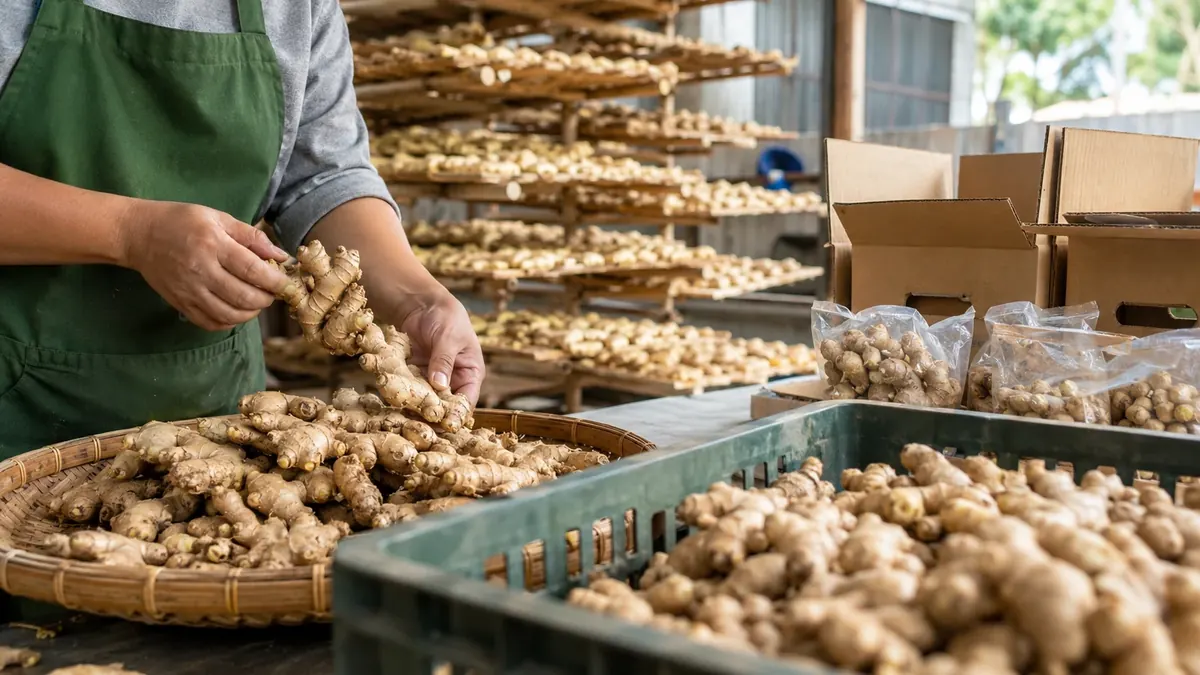
Ginger quality starts at harvest
Ginger is valued for aroma, fiber, cleanliness, skin condition and intended use. Young ginger, mature fresh ginger and dried ginger do not serve the same market, so harvest timing should follow the buyer’s purpose rather than a fixed calendar alone.
Rhizomes that are bruised during lifting may look acceptable at first but can deteriorate during holding. Careful digging, shade handling and fast removal of soil reduce early quality loss.
Cleaning should not create new moisture problems
Fresh ginger often needs soil removal, but washing must be followed by proper draining and surface drying. Packing wet rhizomes into sacks or crates can encourage decay, especially in warm storage.
For dried ginger, slicing thickness, drying surface and protection from dust are important. Uneven slices dry unevenly, creating a mix of brittle pieces and damp centers that buyers may reject.
Sorting separates marketable value from risk
Sorting should remove rotten, insect-damaged, moldy, badly cut or overly fibrous pieces. It should also separate sizes if the buyer uses ginger for retail display, processing, extraction or drying.
A mixed lot forces the buyer to do extra work. A cleaner lot with clear categories usually earns more trust even when the total volume is smaller.
Packaging depends on the product form
Fresh ginger needs packaging that allows ventilation and protects rhizomes from crushing. Dried ginger needs protection from moisture pickup, insects and odor contamination.
Labels should identify origin, weight, packing date and product form. For repeated buyers, lot numbers make it easier to trace problems back to a specific harvest or drying batch.
Ginger needs careful preparation before it looks market-ready
Fresh ginger, dried ginger and sliced dried ginger are not the same market product. The buyer may care about maturity, fiber, cleanliness, slice thickness, drying uniformity, odor, mold and packaging. A rhizome that looks acceptable in the field can lose value if washing, curing or drying is rushed.
For dried ginger, uneven slices create uneven drying. Thick pieces may trap moisture while thin pieces become brittle. Sorting before packing helps protect the buyer from hidden defects and protects the seller from later complaints.
How the references support this article
The sources below provide background on post-harvest operations, food trade and commodity outlooks. Market numbers can change, so this article should be read as educational context rather than transaction advice.
Fresh, sliced and dried ginger need different thinking
Fresh ginger is judged by cleanliness, maturity and physical damage. Sliced dried ginger adds another layer: slice thickness, drying uniformity, color and absence of mold. Powdered or processed forms require even more control because defects become harder to see after grinding.
A supplier that separates product by form and quality grade gives buyers a clearer choice. Mixing all forms into one vague “ginger” offer makes pricing and trust harder.
Where ginger loses value
Ginger can lose value through soil left on rhizomes, cuts that invite decay, uneven slicing, slow drying, smoky odor or packaging that traps moisture. These are not abstract quality issues; they change what the buyer can do with the product.
A practical improvement is to separate fresh, sliced and dried material, then grade by cleanliness and defect level. A clearer offer often earns more trust than a larger but mixed lot.
Preparing ginger for the buyer’s actual use
A buyer using ginger for drying, extraction, retail display or powder does not need exactly the same material. That is why sorting by size, maturity, cleanliness and defect level matters. The more clearly the product matches the intended use, the easier it is to price.
This also helps sellers avoid overpromising. A lot with mixed quality can still be sold, but it should be described honestly rather than presented as uniform.