
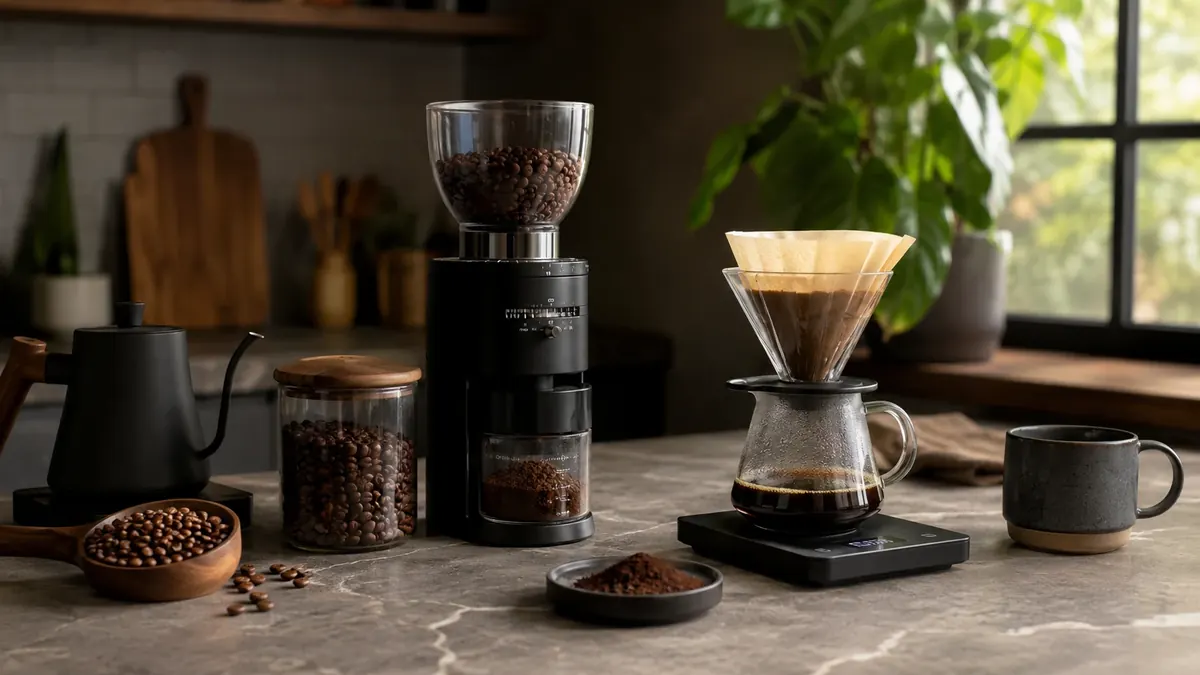
Better brewing starts with repeatability
Home coffee improves when you can repeat a recipe and change one variable at a time. If grind, dose, water, time and pouring style all change together, it is difficult to know what improved or failed.
Write down a simple recipe: grams of coffee, water amount, grind setting, brew time and taste result. A small notebook or phone note can teach more than a new brewer.
Grind size controls extraction speed
Finer grinds expose more surface area and extract faster; coarser grinds extract more slowly. If coffee tastes harsh and dry, it may be over-extracted. If it tastes thin or sour, extraction may be too low.
The right grind also depends on method. French press usually needs coarser grounds than pour over; AeroPress can use a wider range depending on recipe and pressure.
Water quality changes the cup
Water is most of the beverage, so odor, chlorine, hardness and mineral balance matter. Very poor water can make good coffee taste flat or sharp.
At home, filtered water is often a practical improvement. The goal is not laboratory perfection, but water that tastes clean and behaves consistently from one brew to the next.
Freshness matters, but so does storage
Freshly roasted coffee needs time to rest, and old coffee loses aroma. Store beans in a sealed container away from heat, sunlight and strong odors.
Grinding just before brewing usually improves aroma because ground coffee stales faster. If you buy pre-ground coffee, buy smaller amounts and close the package carefully after each use.
Origin labels are a starting point, not a guarantee
A label such as Sumatra, Java, Sulawesi or Bali gives a clue about growing environment and local trade habits, but it does not guarantee flavor by itself. Variety, altitude, harvest selectivity, processing, drying, storage and roasting all shape the cup.
This is why two coffees from the same island can taste different, and two coffees from different islands can sometimes feel surprisingly close. The better question is not only “where is it from?” but “how was this lot grown, picked, processed and stored?”
A more useful way to compare coffees
For everyday drinkers, comparison becomes clearer when coffees are brewed with the same ratio, grind and water. For buyers, comparison also requires defect checks, moisture stability and sample consistency. Origin is meaningful when it is connected to lot-level evidence.
How the references support this article
The sources below support the general background on coffee quality, post-harvest handling and trade. Practices still need to be adjusted to variety, weather, farm scale and buyer specification.
A home brewing example that teaches more
If a coffee tastes bitter in French press, the answer may not be “bad coffee.” It may be a grind that is too fine, steeping that is too long, or water that is too hot. If the same coffee tastes thin in pour over, the problem may be too coarse a grind or water passing through too quickly.
Good home brewing is a feedback loop. Change one variable at a time and write down what changed. This turns daily coffee into a small experiment rather than a guessing game.
How to troubleshoot with one change at a time
If coffee tastes sour, the grind may be too coarse, brew time too short or water too cool. If it tastes harsh, the grind may be too fine, contact too long or the dose too high. Changing everything at once hides the cause.
A useful home habit is to write a small recipe: coffee weight, water amount, grind, brew time and taste result. This makes the next cup easier to improve.
How better brewing saves money
Better brewing can make an ordinary coffee more enjoyable without buying a new machine. If the grind is adjusted, the ratio is measured and water is used consistently, the same beans often taste clearer and more balanced.
This matters because many home brewers blame the coffee first. Sometimes the problem is not the bean but the repeatability of the brewing process.